Thursday, 12 August 2010

Extroverts Only Need Apply

We did another free New Europe walking tour around Dublin and I'm convinced that the tip-based structure is a winner for these guys. They seem to get a lot of enthusiastic tour guides who are a lot more outgoing and friendly doing the tours and we've had a much better experience from the tours we've taken from them.

Our tour guide was no exception to the personality type you'd expect to be doing something like this and the approved method of describing him involved the words "Epic Hair". He looked like a tall ivory walking stick with an orange wig stuck on the top and would have easily been at home as an extra in Braveheart (yes, yes, wrong part of the UK, bite me)

"You can take our walking tours, but you can never take... our freedom"

We started our tour from the City Hall and made our way round to Dublin Castle which is more of an English manor house now as the original was burnt to the ground and only one original tower remains. The statues over the two gates are also interesting as there is a statue representing Fortitude with a rather wimpy lion curled around his feet and another statue representing Justice. This statue is far more interesting as there are several conflicting stories about it's meaning. According to the Dublin Castle tour the statue is facing the castle to show that it was keeping an eye on the English rulers. According to another story the statue has it's back to the poorer inhabitants of the city, showing just what justice was like in Dublin. Interesting to note is that the statute doesn't have the customary blindfold either.

Following on to the back of the castle we learned where Dublin got it's name from the words "Black Pool" and of Jonathan Swift's stay at the castle and the history behind "A Modest Proposal" in which he suggested that to solve the poor's problem they should sell any subsequent children to the English noble classes so that they might dine on the succulent meat of Irish children.
Dublin Castle from the site that was originally the 'Black Pool'

We headed up to Christchurch which houses the remains of a Saxon lord named Strongbow who I'm pretty sure was most famous for his cider. I didn't really pay much attention to this part of the tour. At some point a crazy caretaker (let's face it, is there really any other kind) was cleaning the pipe organ and found a veritable middle-ages Tom and Jerry. The cat had chased the mouse into one of the pipes and gotten stuck. Instead of hilarity ensuing they both died and were mummified from the dry air. Like any caretaker who was a cider short of a six-pack he decided instead of throwing them out he would get a display case and put them on show in the church.
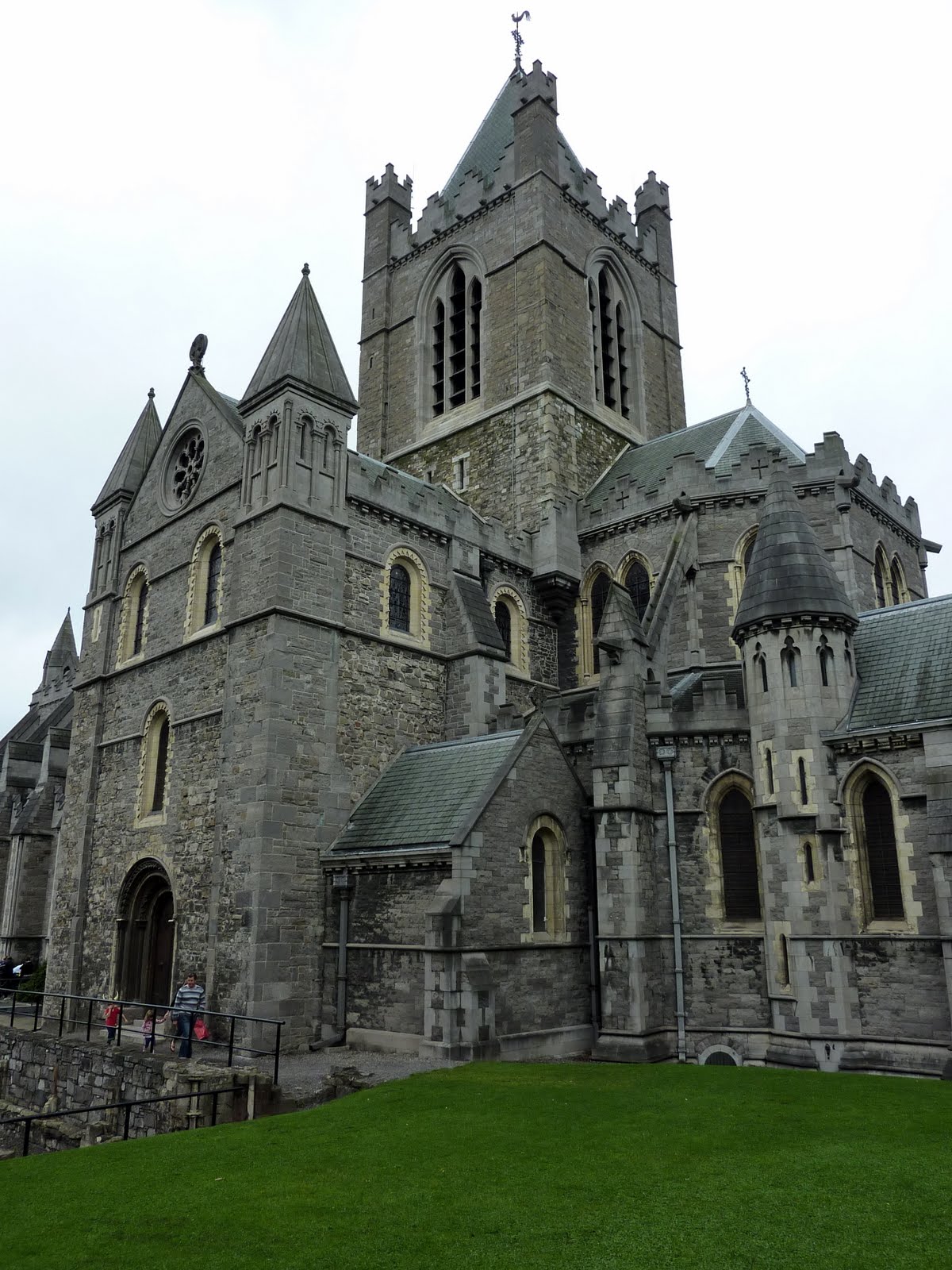
Christchurch is rather imposing

We headed on around the corner to the cities civic offices where there were remains of the cities Viking inhabitants found. Like all good city councils do when history gets in the way of building a nice shiny new council office they eventually got tired of waiting for the archaeologists to be finished and put a nice glass floor over the foundations and built the office anyway.

We forged onwards over the Liffe river, crossing the bank via the Ha'penny bridge which was built by the company that also built the Titanic (constructed right in Dublin, to be sure). We got a nice glimpse of all the scunners drinking along the waterfront as we walked to the O'Connell Bridge which is another icon of Dublin as it is as wide as it is long. We were treated to a short history of the General Post Office and it's role in Irish independence. We also heard a story about Father Pat Noise, a priest who used to rail against the evils of drinking and was eventually run off the bridge by a beer wagon and was commemorated with a plaque on the bridge. The trouble with this is that there never was a Father Pat and the plaque was placed there by pranksters.

The plaque commemorating Father Pat Nois

We then walked down to Trinity College, a bastion of Protestant education in Dublin where Catholics were not allowed to study until only recently. We were regaled with the tale of a bored student who, instead of studying for his exam, was reading the Universities charter in the library one night and found an interesting passage. Apparently Trinity College still has a section in it's charter that allows anyone riding a white horse and wielding a longsword to be treated to a free meal and a pint when they arrive at the University. He decided to test this out during the exam and was promptly told "no" by the exam supervisor. The supervisor thought this was so unusual he was telling the Chancellor and was informed it was still part of the Universities charter. The student was provided with a steak and a pint during the exam, which probably went some was to helping him not feel so bad afterwards when he was informed that he hadn't quite read the whole passage properly. He also needed to provide a stable boy as his horse had wandered off and ruined the cricket pitch. In cricket season. Explusion time.

Rumour has it that if you pass under this structure as a freshman you'll never graduate

We finished our tour in St Stephens Green, a fantastic park in the heart of Dublin. I quite enjoyed the statue dedicated to Wolfe Tone, and we were encouraged to mimic his preferred method of greeting people. Our last story of Dublin was of the many attempts that Ireland has gone through to achieve independence and the many bitter feelings towards the English, for such terrible bastardry as exporting food from Ireland during the potato blight, and to each other as those who thought a part-Republic was better than nothing and those who wanted a united free Ireland.

Wolfe Tone and his preferred greeting

Sunday, 8 August 2010

Dalkey & Kilmainham Gaol

After spending a few days in Dublin walking around Dublin city learning about Dublin's history, enjoying a short boat ride up the River Liffey which divides the city north and south, socially and culturally; we decided to head out to Kilmainham Gaol

Kilmainham Gaol opened in 1796 and closed in 1924.  It worked as a men's, women's and juvenile prison, because men, women and children shared the same cells.  Also some of the leaders of the Easter rising of 1916, the War of Independence and the Irish Civil War were imprisoned and executed there.

The Victorian Wing before the restoration of the Gaol
Walking through one of the many corridors of the Gaol
one of the original cells with name of prisoner carved into doorframe
When the prison was opened Ireland was in the midst of famine.  Even though Kilmainham Gaol was considered the scariest building in Dublin, because public hangings were common and there was no heating or light in the prison cells, many people still committed crimes on purpose to be imprisoned there.  During the famine, for many poor people the prison was the only place where they got food and shelter against the cold.  So they had better chances of surviving inside than outside the prison.


The restored Victorian Wing
Kilmainham Gaol is definitely one of the most best tourist attractions in Dublin. The stories about the prison were really interesting and seeing the cells as well as hearing the stories about prisoners there made the tour fascinating.


Private hanging space of the Gaol
Our next day was spent taking the train out to Dalkey (approximately half an hour away by the DART (train) from Dublin).  Dalkey reminded me of parts of the Southern Highlands in New South Wales, although the Southern Highlands is not a medieval town, it does have many beautiful houses which is home to some rather rich people and celebrities.  One of the more famous celebrities which has a home in Dalkey is Bono, from U2.  The photographs below are just an example of some of the homes on offer on Colimore Road, Dalkey.


However, our main reason of travelling to Dalkey was not to admire the homes, but to see the remains of two castles on the short main street, one Archbold's Castle which had 3 storeys and battlements. The other Goat Castle and the harbour of  Colimore along with Dalkey Island which is home to another Martello Tower and the ruins of St Begnet's Oratory.

Goat Castle takes its name from the Cheevers family who owned the castle in the early 1600's.  Cheevers comes from 'chevre' French translation of 'goat'.  The goat features on their coat of arms.  The Castle dates from the early 1400's when Dalkey Sound was used to off load goods from large ships bound for Dublin.  Some of the goods were transferred to smaller boats and transported by sea to the city.  The tour of Goat Castle had a different approach to most tours whereby they had actors that were dressed up in medieval costumes and presented the tour as if we were back in the 1600's.

Goat Castle otherwise known as Dalkey Castle
 Next to Dalkey Castle (Goat Castle) is a stone Church (that has been destroyed).  It was dedicated to St Begnet and dates back to the tenth century.  It was interesting walking around this site.

St Begnet's Church and 10th century cemetery
From here, we walked down Colimore Road to the coastline of Dalkey, again, it was very beautiful with crystal clear waters and many fishermen.
Colimore Harbour, Dalkey
Whilst we were enjoying the scenery and taking a short break, the weather decided to turn ugly and suddenly grew very grey, at this stage, we decided to head back to the train station and return to Dublin.

Colimore Harbour & Dalkey Island in the background
Another view from Colimore Harbour, Dalkey

A Day Trip to Northern Ireland

Leaving Dublin we got onto the motorway, recently developed mainly to get the trucks out of the city.  However, when they built the motorway tunnel they didn't compensate for the European trucks and Dublin Port Tunnel was built 3cm too low for the super trucks which still have to go through the city.  Dublin seems to have not a great deal of success in construction.  Another example would be the The Millennium Spire, which was supposed to be finished in 2000, however it was finished in 2003, no longer able to be called the Millennium Spire and now goes under several 'alternate' names (such as "The stiffy in the Liffey"). 

First stop of our Northern Ireland tour was a place called Carrick-A-Rede and Larrybane.  Carrick-A-Rede means "the rock in the road".  The road in this case is the sea route for Atlantic salmon on their westward journey past Carrick Island.

Sancha crossing the rope bridge
For over 350 years fishermen have strung a rope bridge 30 metres above the sea to allow them to cross and access the best places to catch migrating salmon.  The views are spectacular once you cross and I also managed to get over (just told myself not to look down). It was an achievement to say the very least since I hate heights.

Larrybane Headland
Larrybane or Laragh Ban means the ancient white site, and is the name of the limestone headland lying to the west of Larrybane Bay.  An iron age fort stood on the headland around 800 AD.  Absolutely stunning views of not only the headland but also over the sea to the Scottish coast.

Next stop was Giant's Causeway about a 10 minute journey from Carrick-A-Rede.  I was eager to see this UNESCO World Heritage site as I had read so much about it and seen a ton of beautiful photographs in tourist brochures.  Let's just say, I wasn't disappointed.  The rain and the wind managed to hold off for this trip too, thankfully.  I have noticed that Australia seems to have the whole safety issue(s) down pat when it comes to cliffs and viewing platforms - they actually have the area surrounded by fences or wooden boxes.  Here, however, there are only a few fences, you can basically just walk out onto the cliff in most places and see the sheer drop below. All the while hoping that no big wind storm is going to suddenly approach and blow you off.

Giant's Causeway Headland
I was intrigued with this site as the Giant's Causeway has formations of unusual six sided basalt columns and numerous walking tracks around the headlands. It is also tremendous for photography. After closer inspection, some of the photographs I took came out as if I had painted them.  I wished that we had longer to explore the headlands as I spent most of my time around the Giant's Causeway stones, such a surreal environment set against a green (headlands) and blue (atlantic ocean) background gave off contrasting colours in the stones.  I loved it.
Giant's Causeway Basalt Columns (it's a photograph, not a watercolour)
Then it was time to head to Derry (or Londonderry, depending on who you ask).  We stopped for a quick photograph of Dunluce Castle which would have been nice to have time to wander through, but I guess with tours you are always running out of time or waiting for someone who has made the group late.  However, Dunluce Castle is gorgeous and is thought to be the most romantique and picturesque Castle in Ireland dating back to the 14th Century.   Our bus driver had a great saying though "Do you know that song by U2 'With or Without you?, well if your late, we will be going 'With or Without you'" (we thought that was pretty funny).

Dunluce Castle in Portrush
After about an hour and a half's drive we arrived in Derry.  The town is also known as Londonderry by the English, and is one of the longest continuously inhabited places in Ireland.  The name Derry derives from the old Irish word 'Daire' meaning oak grove.

Once we hopped off our tour bus we joined a walking tour of Derry, somewhat disappointed that we had such a large group (50+) as it was difficult to hear at times and we were also restricted to what we saw, because moving a large group of adults and children is somewhat slow. We started off with a tour of the City Walls, one of most visibly striking historic features of the city is the historic walls.  It is the only remaining completely walled city in Ireland. The walls were built between 1613 and 1618 by The Honorable The Irish Society as defences for the early 17th Century settlers from England and Scotland.  The prefix London was thus added to the name of the city and the city became known as Londonderry.  The walls which are approximately 1.5km in circumference act as a unique viewing promenade and form part of the walkway around the city.
Historic City Walls in Derry
My favorite part of the walking tour was the famous murals that are throughout the city which have had the world's media attention in both the Bogside around Free Derry Corner and the Fountain which are testament to the role Derry played during 'The Troubles'.  They are known as the Bogside Artists, the series of 12 large-scale murals depict key events in Northern Ireland since 'The Troubles' began in October 1688.
Bogside Mural
This was our last stop of the tour and we began our journey back to Dublin.

Giant's Causeway Basalt columns


Giant's Causeway Basalt Columns with Headland in background

Free Derry Corner
Derry or Londonderry Loyalists side
Giant's Causeway

Tuesday, 27 July 2010

Portugal Sightseeing

I wasn't sure how we would take to Lisbon as our first impressions after getting off the train were of a dirty and poor city, due mostly to the homeless man urinating in front of us. I'll just put it down to a tourist experience.

We have enjoyed our two weeks here in Lisbon and have managed to do plenty of relaxing as well as sightseeing. We were lucky enough to get tickets to a 3-day Rock Festival near Sesimbra in Portugal that showcased a number of International acts such as Prince, Stereophonics, Vampire Weekend and Julian Casablancas (of The Strokes) just to name a few. Of course one of our favourite acts was Prince. It was truly another amazing experience.


As for sightseeing, we took a day trip out to Belem; it is referred to as the historical heart of Portugal. The entire area of Belem is closely associated with the Portuguese Age of Discovery. The natural harbour made it an ideal launching point for the exploratory voyages which turned Portugal into a major economic force. In 1755, Lisbon and the surrounding region including the Belem area, suffered through a devastating earthquake. As fate would have it, much of Belem was spared.

We visited the Tower of Belem which was not for the claustrophobic. The narrow staircases up and down only wide enough for people going up or down, not both ways and the dungeons below where you had to crouch as the ceiling was not high enough to stand. Overall, even though it was a fort, it did look magical and fairytale like when you climbed up to the very top of the tower and could see views of Lisbon and the castle.

Tower of Belem

The Oceanarium was also a great day out. I think we have seen a lot of fish on our journey through Europe, however, this Aquarium would have to be one of the better ones. The Oceanarium is primarily a giant tank that you walk around on 2 floors with many smaller tanks on the sides. There are then open areas that have different climates within - of note is an area where the penguins swim around. We also got to see a weird Ocean Sunfish (that I've never seen before), some Puffins and an Otter. After, this we exited and went for a ride on yet (another) cable car - this one was pretty boring - we got to see the site from Expo '98 - which was mainly just ugly eyesores and views of the River Tagus and the Vasco Da Gama Bridge.

 
Ocean Sunfish at Oceanarium

In the evening we ventured out to the streets in Bairro Alto as that's what the culture is like here. You basically find a bar, which is easy as hell, order a drink - which is usually a Mojito (a very potent one at best) and then consume it out on the street. After about 4 of these and feeling a little bit intoxicated, we moved onto a reggae bar where we met a few locals - Marco, Christian and Rodriguez and continued to learn about Lisbon's culture whilst drinking Lisbon's beer of choice Super Bock. It tastes much like VB I'm afraid to say. We woke with strong headaches the next afternoon.

After wasting another day with a hangover, we decided to make it up by eating and visiting the Santa Justa Elevator. We all know what a huge fan David is of Portuguese chicken, so lucky for us, we scoped out apparently the best and most juiciest chicken in Lisbon (we beg to differ, Petersham chicken shops in Sydney give them a run for their money). After the feast at the Bonjardim restaurant we headed home to have an early night so we could appreciate the next day.

Santa Justa Elevator Shaft

After having a quiet night in and being able to sleep in (again, seems to be a recurring theme, these days) we set off on another day trip to Cacilhas and Costa da Caparica. We took a ferry to Cacilhas which lasted about 15 minutes and then took a 35 minute bus ride to the coast of Costa da Caparica. This beach reminded us a bit of places in Queensland. Although there was not much there, there seemed to be a lot of people on the beach and in the water. Nice enough beach but I much preferred Cascais.

Costa da Caparica

Following on from this, the next day we spent sightseeing Sintra, Pena Palace, Cape Roca and Cascais.

 Cascais


Monday, 19 July 2010

Lisbon, A Giant "Fuck You" To The Disabled

If you're wheelchair bound or on crutches in Portugal you've got it tough. Between the slippery cobblestones, treacherous steps, and massive hills with narrow pathways barely wide enough for one person this seems like a city designed to weed out the mobility challenged amongst it's population. I don't think I've seen a single wheelchair ramp or wheelchair accessible train station so it looks like the only option would be to latch on to the back of one of the recklessly fast taxi's that hoon about the streets. I'm pretty sure most of the cab drivers base their fare structure on how scared their passengers are by the end of the ride, and their tips on how many near death experiences that they graced various pedestrians with.

It's no wonder that the inhabitants of Bairro Alto all seem to be so fit, there are some hills so steep in this suburb that there are special trams that run up and down some of the hills. A few of these are specially modified so that the wheels are at a 30° angle to the main body of the tram. I'm wishing that our tourist map had altitudes as well as just streets as it seems to take us much longer to walk anywhere with Sancha taking quick rest breaks between each section of steps.

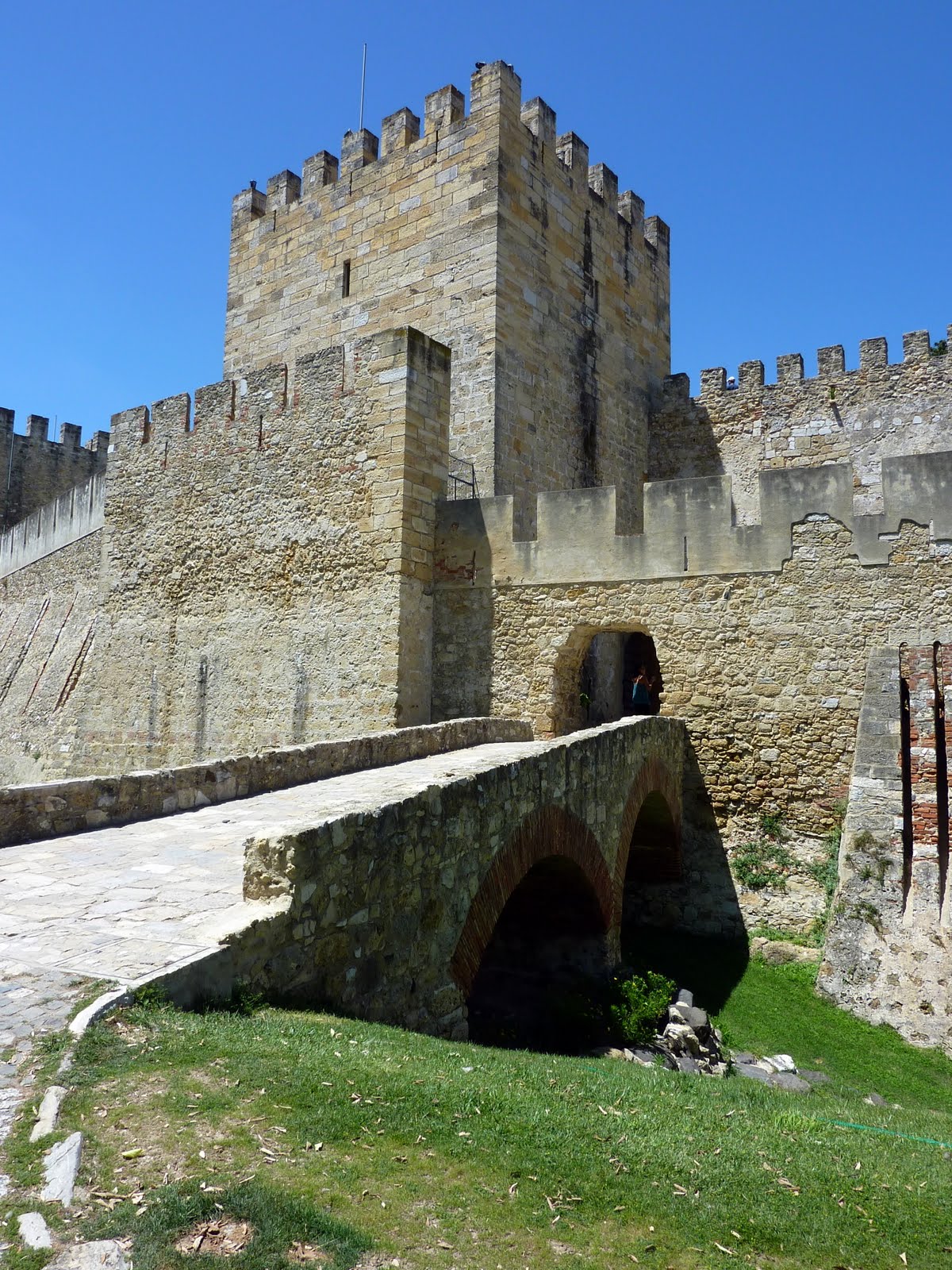
On the bright side the large hills means a spectacular view of the city from the Castelo de São Jorge that we visited. The castle even has a camera obscura with a periscope which is used to give 360° views of the city from the top room of one of the castles towers. One of the more impressive sights is the 25th of April Bridge (which looks quite similar to the Golden Gate bridge) and the massive Christ the King monument standing nearby (which was inspired by, and looks quite similar to, the Christ the Redeemer statue in Rio de Janeiro). The castle, like most other places in Portugal, also comes fully equipped with a bunch of old guys playing cards.

We also took the opportunity to go and get some authentic Portuguese style roast chicken. It was so good we went back another night for dinner and had even more awesome Portuguese cuisine, including some fantastic whole grilled sardines.

Castle of São Jorge

25th of April Bridge

Camera Obscura in the Tower of Ulysses

Old guys playing cards in the castle courtyard

Tasty, tasty chicken. Or what's left of it by the time we remembered to take a photo

I'm gonna eat you little fishy!

Friday, 16 July 2010

Madrid

Madrid was a city we did not intend on going to at first, although we decided to have a stopover to break up the 15 hour train journey from Barcelona to Portugal.  Lucky we did get to stay in Madrid - otherwise we would have totally missed out on being lucky enough to celebrate with the rest of Madrid and Spain on their World Cup win against The Netherlands.


We began our first few days in Madrid slowly, as David was sick and I was busy caring for him in our Hotel room.  We were then surprised to find out friend's of David's from University - Roxanne & Grant were in town as well, so we spent time with them - watching the World Cup finals - David finding a friend (a man who accosted David and soon wanted to spend most of the evening hugging him and touching his neck, it was quite funny.  Just picture this - the biggest bogan - drinking white wine out of a flute glass, caressing David's neck and yelling into his ear in Spanish and the word "España" every fourteen seconds).  Luckily for David, Spain won and his new friend went off to find his friends.


From here we continued to drink copious amounts of alcohol and then went home, wasted the next day and then went walking around the city - around to the Temple of Debod; Royal Palace; and parklands and then returning in the evening to meet Roxanne & Grant for more sangria, tapas and shisha.  Another random outing.


More tapas and sangria was consumed the next day - we did some gift shopping and I brought some perfume as I was sick of smelling like sweat all the time - deodorant just doesn't cut it sometimes! (it's just 30+ temperatures, roll-on deodorant, I end up smelling worse than when I put the roll-on on).

The day before the World Cup Finals - it was just magical - seas of red and yellow (a bit different from Bangkok as they were seas of excitement and happiness).  The city was covered in flags, people, vuvuzela's (which gave me a constant migraine), people dancing, singing, you name it - the city had it).


The day of the Finals came and people where out early - again - seas of red and yellow.  The square was full of people, so we decided to head to a bar, where we could see the T.V. screen and not be killed just in case Spain lost.  We got there a bit late so we got the better of the "crap" tables, but we were able to see. 

It was so fantastic to be amongst all the Spanish fans - just so exciting to be apart of it!  The bar was fun - we had jugs of sangria (again, seems repetitive, but it's yummy - most of the time); some more tapas and enjoyed the game.  It was awesome that Spain won.  The streets were mayhem - fireworks going off at every street corner, crowds chanting, people dancing, boys chasing one another - again you name it, it was going on).


No sleep for us as the party went on all night and all morning, we ended up getting some sleep and waking up at 4pm the following day.  The city was still crazy - music and parades going on throughout the city.  We ventured out down the street and then waited around for the grand parade of the Spainish champions to hit the streets and thank their fans.  Again, we were lucky enough to be in the right spot at the right time and were able to catch a glimpse of the sporting champions.

Our last day in Madrid, we spent 5 (five) hours at the Prado Museum and lounging in the Jardin Botanical Gardens before heading back to the hotel to collect our bags and depart for Lisbon.