Showing posts with label czech. Show all posts

Sunday, 30 May 2010

Sächsische Schweiz Broke My Knees

So apparently hiking all day makes you tired. I am learning so many new and interesting things on our trip. Also painful things, apparently my knees don't enjoy several kilometres of going downhill. Between that and Sancha's busted knee that dislikes going uphill we're pretty much restricted to flat surfaces now. Sucks to be our knees I guess.

The hike itself was about 12km to 15km long, worked out by using our fingers as a makeshift ruler on the map and then measuring roughly where we had been. Judging by the amount of hurtyness we have the day after the hike I'm thinking it was more like 100km or so.

Our day started at about 9am when we left the hostel with our guide and group and headed to the Neustadt Train station. The train we would normally get on apparently had some sort of mechanical problem so we had to run to catch a different train so we could get to the main train station and get on to the train that would take us to near the Czech border. After making a dash for it, and almost missing our new train, we were on our way. Our guide also pointed out several things we missed on our previous train trip from Germany to Prague such as the Bastei Bridge, a large mountain fortress and the old German border crossing building which is now abandoned.

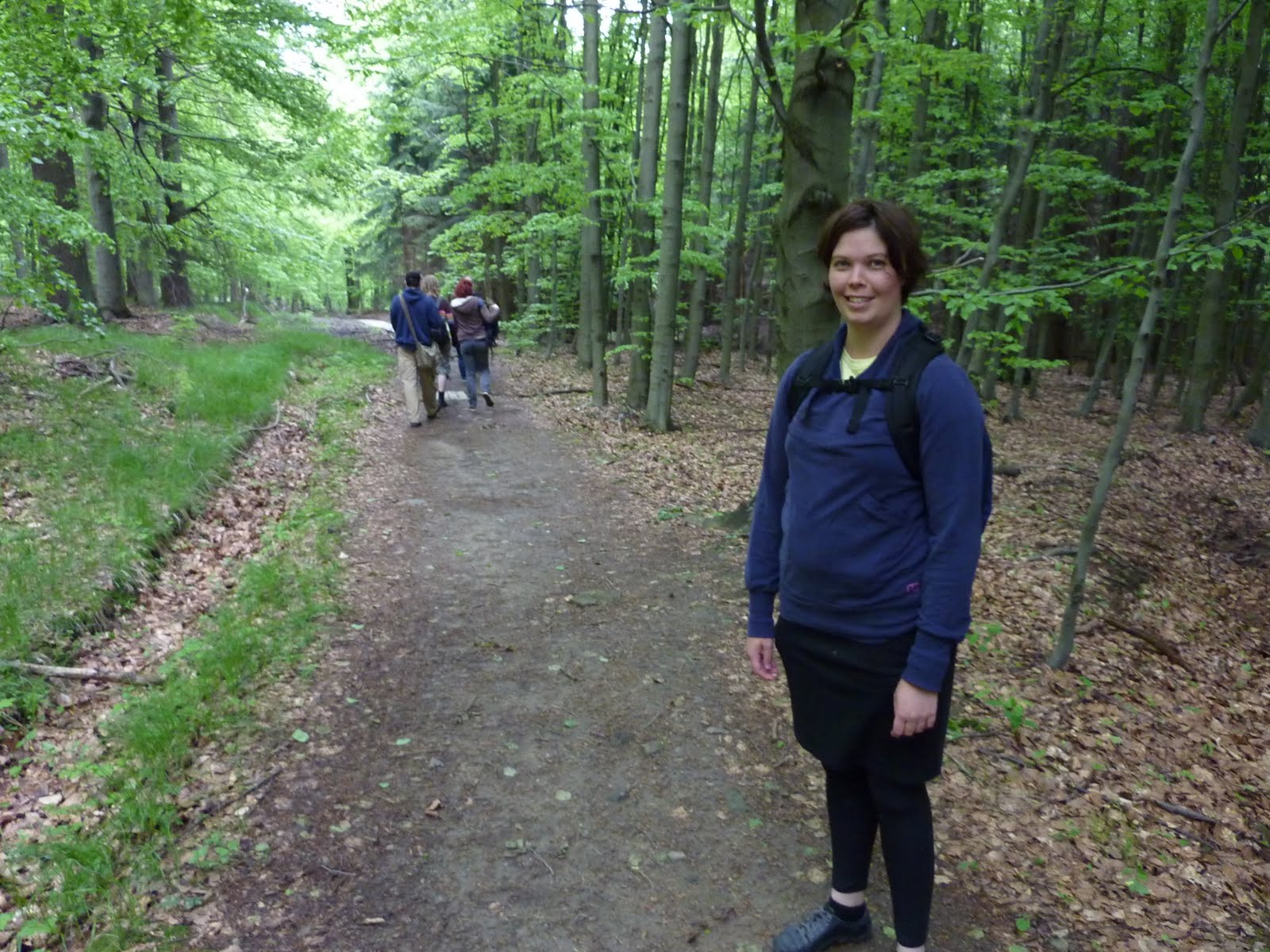
We hopped off the train at Schmilka, the second last stop, and then took the ferry over the Elbe to the town itself. The start of the walk wasn't pulling any punches either as these were steep, cobbled streets we made our way up until we were through the town. We proceeded up an ever increasingly steep sealed tar road, which eventually turned into a gravel path. This was the easiest part as it's the road to the restaurant at the top of Grosser Winterberg (literally Big Winter Mountain). Things got a bit tougher as we turned off this road and onto a gravelled hiking trial leading us further up the mountain and our group was slowly shedding excess jumpers and beanies from the exertion.

By the time we made it to the restaurant at Winterberg we were glad for the break as we'd been climbing uphill for several hours. We ate our packed lunch (cobbled together from the various breakfast ingredients at the hostel) and made the most of our time to sit down and rest. We also (briefly) saw a few of the sights as the restaurant has been there when it was a hunting lodge built in 1848 and the food was brought up in horse drawn carts (during the summer only) and kept in a special ice-house, which has now been turned into a small area with some information about the area.

We continued on after our lunch on a thankfully much flatter, but quite muddy trail and after a while reached a lookout where we could see down into a valley and a few of the other sandstone peaks in the park. The view was quite spectacular, yet a little freaky, as we are used to our National Parks and surrounding countryside being a little more brown. This was plush greenness as far as you could see and I kept thinking to myself that this would make an excellent Sherwood Forrest (preferably with a Robin Hood who can speak with an english accent)

A quick break for photos at the top and then we were off, down more muddy trails and several kilometres of downhill that completely wrecked my knees. Once we were at a more sensible elevation we eventually broke off the marked hiking trail to travel along an old smugglers path that was once used to move goods over the German and Czech border. We followed this for some time and reached several small white stones that mark the border and several signs warning us not to proceed. We waited around for some time for the border guard but no one showed up and we continued on, past a logging camp and a few memorials to the German inhabitants of this region to the town of Mezni Louka where we ate a hearty lunch of Goulash. With dumplings for me, and with mashed potato and a strange look from the waitress for Sancha. Washed down with several Czech beers we were ready to be on our way again.

Since we had just missed the bus back to the train station we decided to take a walk a little further down the road to Mezna, the previous stop to where we had lunch. We passed several monuments to the inhabitants of the region who had gone off to fight in various world wars and we eventually reached the town where most of out group parked themselves on the bench to wait for the bus while our guide and myself decided to explore the town. This didn't take long and not far down the road, past several abandoned buildings, we had hit the end of the town. We thought we would go and check out the kayaking that was down by the river, but the sign indicating that it was half a kilometre down a steep, windy path quickly put an end to that idea as our bus was due soon.

A quick bus ride back, a shoddy coffee at a hotel in Hrensko, then a ferry over to the train station and we were on our way back to Dresden. All of us were a little exhausted after our days trek but rather satisfied with our hike.




Monday, 24 May 2010

Beer! Glorious Beer!

If theres one thing Plzeň is famous for then it's drunkn foreigners mispronouncing the name. Second on the list would be the several beer breweries. A close third would be the Skoda car plant, but that's only really useful if you need to drive somewhere to get beer.
The most famous in the area is the Pilsener Urquell brewery which has over the years, along with the Gamrinus brewery, been acquired by the SABMiller company. It's a little sad that something so vital to the Czech economy (and way of life for that matter, Czech's drink a lot of beer) has been acquired by a faceless corporation but it's also helping get tasty tasty beer to other countries like Australia, so I can forgive them for that.
History seems to be quite important at this brewery as they have kept most of the old, and occasionally original, buildings and structures. From the outside as we milled about we could see several of these including the main gate, an old water tower, brew house, and several of the old barrels used to hold the beer whilst it was fermenting. Another important thing seems to be public image as the whole tour was very swish with a defined route, bus that takes you between some of the more distant buildings, and a multimedia presentation on the beer brewing process. They've even turned the old brewhouse into a museum for part of the tour. This detracts a little bit from the whole experience, but you get over it rather quickly once you hit the beer tasting.
As part of our tour we saw the packaging plant, which sounds terrible until you get in there. This is where they put beer into cans and bottles and the machinery required to wash, label, fill, and test all the bottles and cans is mightily impressive. We unfortunately arrived when they were cleaning and performing maintenance on the bottle filling machines but we did get to see the can filling machine in action.
We moved on to the old brewhouse where we saw the old copper tanks used to boil the water, barley and hops. It turns out that the method of triple boiling was originally an accident, as the Czechs had obtained the services of German master brewer Josef Groll and upon seeing what he thought was terrible ingredients he ordered them to be boiled three times (instead of the usual one). The result ended up being rather unique and the technique is still used today. We also tasted each of the main ingredients used, barley, hops and malt, either in their grain form or powdered in the case of the hops.
Next stop was the new brewhouse, a large glass affair but still with large copper tanks used to boil the ingredients. The tanks used are still copper and are heated by a direct heat in the same way the brewing has beer traditionally done except for the two large stainless steel filtration tanks that are a more modern addition.
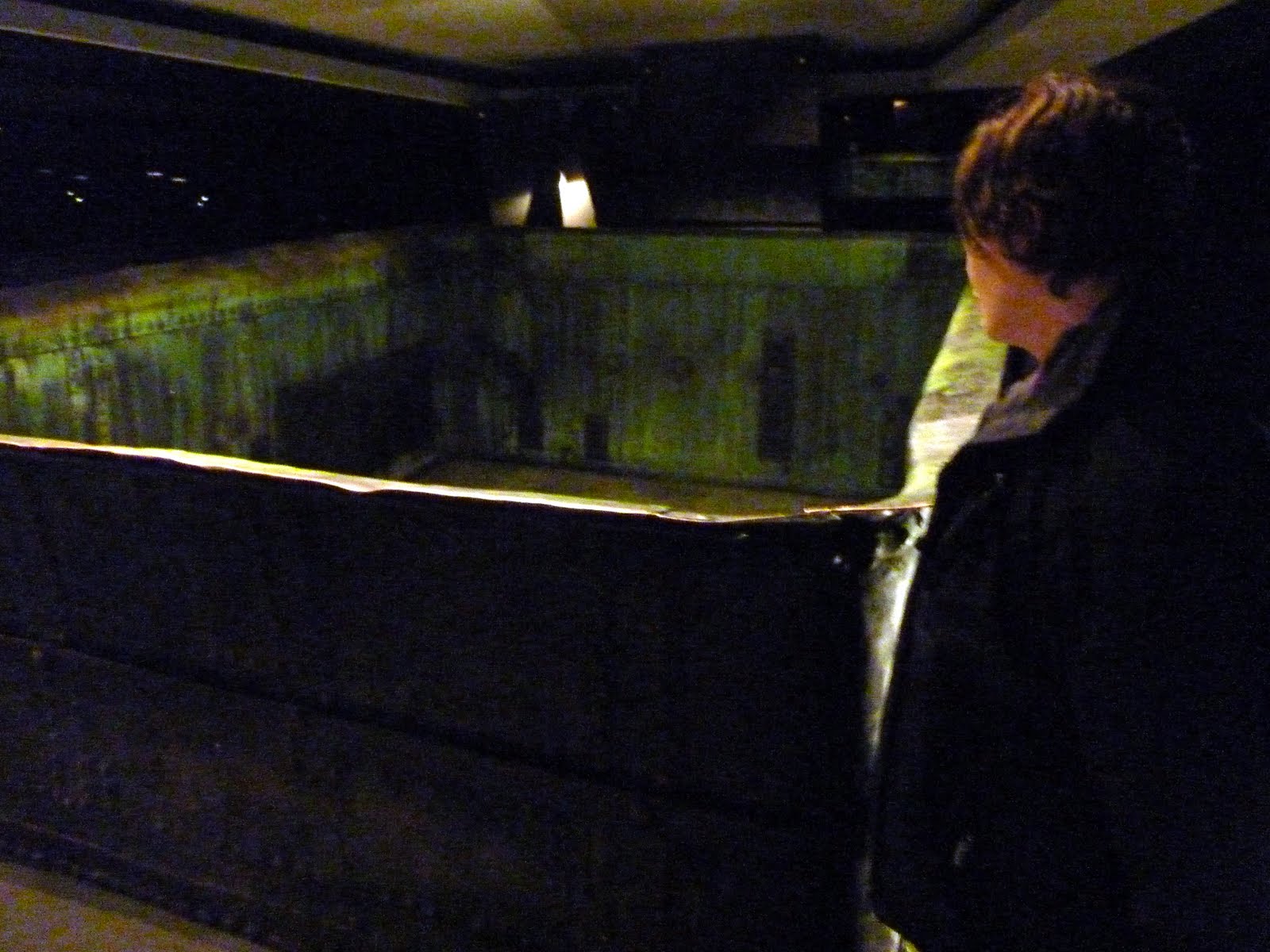
We headed back out through the old brewhouse again and on the way saw the first open steel brewing container that was used to brew the first Pilsener Urquell batch of beer.
At this point we were approaching the crux of our tour, the beer tasting part. We descended into the cellars below the plant which are kept at a frosty 7 degrees. The process produces a 'bottom-fermented' beer which is produced at a much lower temperature than other beers, using a yeast unique to Pilsener Urquell (which is even stored at several different yeast banks around the world). While they use big tanks now a small amount of beer is still brewed in the cellars in the large barrels and we got to taste some unfiltered, un-pasturised beer which was an excellent end to out long walk. We only walked thorough a few hundered meters of tunnels on our tour, but there are still several kilometers of tunnels beneath the brewery that were carved out over many years to make room for all the beer that was brewed there.


Hammer and Nail

Well going out in Prague is certainly more interesting when you've got a few locals to show you the ropes. Plus it also helps when you don't have that much to do the next day, it makes drinking a few liters of beer on a school night seem a lot less... bad.
Nail Bar in Prague (I have no idea of it's real name) is a little bar in Praha 2 with a game that would certainly be banned within seconds in any Australian pub, club, bar, bistro, or even backyard. Pictured is the lovely Dita posing with the hammer and one of the large gauge nails used in the game, along with the giant chunk of tree stump. This bad boy is filled with nails that have already been hammered in and it's surface is covered with chunks of sawdust from all the miss-hits of nails from previous games.
You start by nailing in one of these large nails for each player, using the back of the hammer as a measure to make sure they all start off at the same height, and then each person gets one swing of the hammer to try and drive their nail into the tree trunk. You only get one swing regardless of whether you hit or miss and then pass the hammer on to the next person. The trouble is you're using a hammer with a chisel head on the back and you have to use this narrow part to smash in your nail, which also gets a lot more difficult after a few beers surprisingly.
Add to this that the loser has to buy shots (or beers if no one wants shots) for everyone and you have one mean drinking game.
Pictured below is my souvenir woodchip that I knocked off the tree in my first game.

Thursday, 20 May 2010

Magic Games

Oh, what a night we had last night.  We met up with a friend we briefly met on a walking tour of Berlin who now lives in Prague and several of her friends for some beverages and some rounds of ten pin bowling.

The venue (called Magic Games) itself was an interesting spot.  It was in the basement of an old building in Prague 10. You walk down a set of stairs and your at the bar, then to the right hand side there are 2 bowling alleys and to the other side there is a pool table, darts and pinball.

The ten-pin bowling was old-school - the pins were on strings and the lanes were very short.  You could basically bowl bare foot if you wanted too (Dita did) and you paid per hour instead of by game.  It worked out to be less than $5.00 AUS, so cheap!

We had many rounds of beer, tried some Czech cheese (Nakládaný hermelín) it was really tasty.  We also got to try some Czech shots which were referred to as "coffin varnish remover" and it tasted like it too.

It was the most fun we have had in Prague so far.  Tomorrow, we pack our bags and head for Dresden.

Sex & Torture in Prague

On our way home from the Prague Underground Tour we ventured into the Sex Machines Museum situated just off Old Town.  The Museum purports to be an "...exposition of mechanical erotic appliances."  Apparently there are sex museums all over Europe, but this one is unique because it focuses on the apparatus people create to try to enhance their sexual pleasure.

It was 250 crowns each (around $10.00 AUS) for admission which was a bit rich, but we paid it anyway. We saw some..erm..mechanical erotic appliances dating back to the 1500's. Some of the things in this museum are quite simply wrong and should not exist - but you absolutely have to go and see them if you're ever in Prague.

The first room had a bra with openings, a love seat and a man's robe with a convenient opening.  The next room actually had a 1925 Spanish porn movie on - it wasn't gratuitous porn, just very very funny.

Other rooms had various old-school methods of contraception, various pouches, walking sticks, belts, mechanical devices, chairs and even wall-mount signs describing various positions.  One display showed piercings that looked like they really could hurt!  I could not believe we were allowed to take pictures! We took very little anyway.  It was an experience to say the very least.

I'm Going Deeper Underground

It's interesting to see how many cities we've been to that have an underground tour. Prague is a city that used to be much lower and it turns out all the old buildings we've been wandering past on the street used to be the first or second floor.
In the old town square, and more specifically the old town hall, there's a room with large tiled mosaics on both walls. Mostly it's used for weddings nowadays but the door pictured leads down to some of the preserved buildings underneath the (current) street level.
Getting down there was much less involved than in Berlin as most of the rooms were used up until quite recently. That and they were never meant to be shelters of any kind, several rooms being used as store rooms or in some cases prisons.
The first room contained a giant burnt cross, one of the many religious symbols that had suffered at the hands of the many religious purges in Prague's history. When the citizens aren't busy throwing town councils out of windows that is. Also along the wall are statues of many of Prague's more famous and influential people including King Wenceslas, a great favourite among the Czech people.
As we continued down we passed through what was once the ground floor of the tower, and then through several old houses which had each been built with a common wall to save on building materials. This was not terribly successful when people had, as we saw in one room, large ovens in their houses and fires quite often broke out. The oven we did see was constructed by Italian immigrants and had several small bones peppered through the stonework. They had taken all the household animals that had died and incorporated them into the oven to keep the good luck in the house.
As we passed over a bridge between houses we saw what was once the original street level a few metres below us and discovered why this had all been buried. During Prague's expansion into a town from a little village on the river no town fortifications had yet been built. Add to this the problem of the river rising and flooding the town and both problems were solved in one go. When building a fortified wall around the town a moat was also dug outside. This earth was used to raise the level of the streets, essentially burying the first level of each house underneath the new streets.
We also saw an example of Prague's old heraldic emblem. The version we saw shows the gate of the Charles Bridge and this was later modified to include a sword in front of the entrance after the residents successfully defended themselves from an angry invading Danish army.
We also saw several replicas of various pikes and weapons used at the time and a measuring device which included scales and the standard unit of measurement in Prague.
All in all another fascinating tour with a lot of the history of Prague revealed and sights we wouldn't normally see just wandering the streets on our own.

Tuesday, 18 May 2010

Kutna Hora

Kutna Hora is a wacky place, it is located about 69km east from Prague and has had UNESCO World Heritage Site since the mid 90's.

Historically the once substantial wealth and politico-military power of the town(s), especially between the 13th to 15th centuries, was founded on the copious deposits of silver and the attendant boom in silver mining that occurred in the region. However, this has not been the case for nearly half a Millennia now as the towns principle silver mine was irretrievably flooded in the mid 16th century.  The towns’ prestige also eroded drastically over the centuries through the deleterious effects of various wars, the Austro-Hungarian occupation and numerous devastating plagues.

Our first stop was the eerie Sedlec Ossuary. I can’t deny that principally it’s my morbid curiosity with regards to the ossuary, one of the town’s main tourist draws I think, that has drawn me here today.

The Ossuary houses four enormous bell-shaped mounds of bones and occupy the corners of the chapel. An enormous chandelier of bones, which contains at least one of every bone in the human body, hangs from the centre of the nave with garlands of skulls draping the vaults.  One other prominent “artpiece” is the large Schwarzenberg coat-of-arms.  Of the large amounts of bodies bequeathed to the earth as a result of recurrent, severe plagues; 30,000 bodies are estimated to be buried here from a Great Plague in 1318 alone!  This is possibly not a spot for the easily spooked or squeamish but I think this is a really great, not run-of-the-mill sight to see if you’re up for the trip out to it.

Our second stop was St Barbara's Church which was an amazingly beautiful 3 spires Gothic Church. It houses a lot of renaissance and baroque artwork.  The church is visible all over Kutna Hora. Amazingly, construction of this church began is 1388, but was not finished until 1905.


Onwards to the Kutna Hora town centre and a very becalming and pretty one it is too.  The beauty of Prague, but a much quieter and smaller one.
There are many more churches and a museum of the old royal mint.  This involves a local guide which shows you some of the old coins under each King.

This was quite an interesting tour, although again our tour group kept to themselves a lot and weren't interested in chatting to us, we're beginning to think we're frightening :(

After this 6 hour journey, we again went and had a hearty meal and dessert at Cafe Slavia and then a walk along the river before we headed home to rest our tired eyes.

Tomorrow, we do an Underground Tour of Prague's Old Town and a Dinner Cruise along the river.

Monday, 17 May 2010

Ahoj Prague

We departed Berlin on the 14th May (we were a bit sad to leave Berlin, as we had enjoyed it so much) and arrived in Prague after our 5 hour journey by train.  After spending about half an hour in the main station trying to work out the zones and where to buy our tickets from, we were on our way arriving at our destination with few arguments.  We are staying in Nove Mesto (New Town) and we have been here for 3 days now - enjoying all the delicious food and beer.


On our first night we went to Pivovarsky Dum - a small microbrewery just a block from where we are staying.  We tried 0.5L of Štěpán each, which is a classic style czech pale lager with our meals - it was delicious.

Yesterday, we spent our day at the Czech Beer Festival in Letnany. Once we figured out where to buy a ticket from and that we needed a day ticket we were on our way.


We arrived quite early, not knowing what time it opened.  During our wait we came across some English lads from Liverpool on a stag night.  We enjoyed their company for most of the afternoon/evening before we parted ways to go home.
The beer festival was great and so was the food. We drank about 4-5 litres of beer each!


Today, we spent the day walking around Stare Mesto (Old Town) soaking up the beautiful architecture and old facades. We then had some lunch at Pastacaffe - great pasta dishes. Then for dinner we ate at U Pravdu which is just downstairs from where we are staying.  David enjoyed some pork ribs (1kg) and I a sirloin with potatoes, garlic, onion, bacon & cheese in a scallop pan with 0.5L of Pilsner Urquell (seems to be a popular beer in Prague). Again, very delictable, but oh, so very full.

Tomorrow, we head to Kutna Hora.